Your AI assistant should read facts from a database, not guess.
AI coding agents start every session cold and re-infer project state. The dc tools replace that guessing with deterministic, queryable facts served over MCP.
The problem
Every session starts cold. The assistant re-explains, or guesses.
What was decided, what's mid-flight, how the code hangs together — re-inferred from scratch, every time. Re-inferring isn't just slow: it burns tokens re-reading files the agent already read yesterday. TODO.md rots. GitHub Issues live per-repo, behind an API the agent can't casually use.
- “Let me re-read the codebase…”
- Stale TODO.md as memory
- Decisions lost between sessions
- Hundreds of reads to rebuild context
- Plausible ≠ true
- One user-scoped database
- Read & written over MCP
- Append-only ledger of decisions
- State read once, not re-inferred
- Same input, same answer
What it saves
Context comes from the database in one compact read — not re-inferred from the repo every session.
Recent changes are a query — changelog, items, decisions — not a blind grep expedition across the repo.
State goes to the ledger over MCP — no TODO.md churn, no status docs to keep in sync.
The tools
dct
v1.2.1 · availableCross-project work tracking for AI coding agents. Issues, todos, sprints, decisions and session handoffs in one database your agent reads directly — built for Claude Code, works with any MCP client.
github.com/fotodeveloper/dct →dcg
in developmentA deterministic code knowledge graph. Your codebase parsed into a graph database — language, framework and business-logic relationships — queryable over MCP.
read the teaser ↓End the day with /handoff. Start the next with /pickup.
The next session resumes exactly where the last one stopped — same open threads, same decisions, same plan. No copy-paste, no re-explaining.
- Session handoffs/handoff flags the sprint — what's in flight now — and leaves a prompt for the next session; /pickup reads both and resumes, across projects.
- Append-only ledgerNotes and decisions are soft-deleted, never dropped.
- Gate checkpointsA feature can't resolve while its gates are pending — dogfood, security, review. Enforced in code.
- Changelog-firstA hook blocks git commit when app code changed without a changelog entry — the log writes itself, and /release is one command.
- One-read pickup/pickup restores state in a single structured read — no repo re-crawl, no wasted tokens.
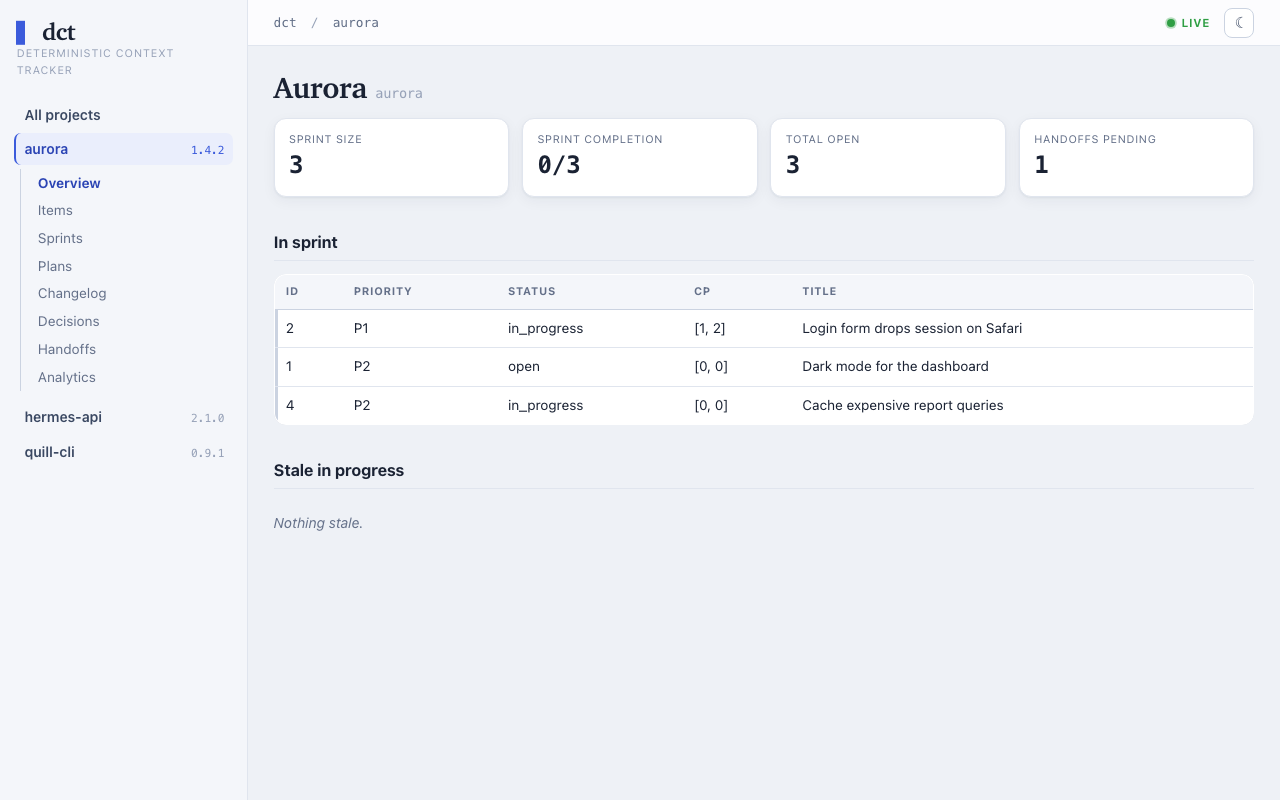
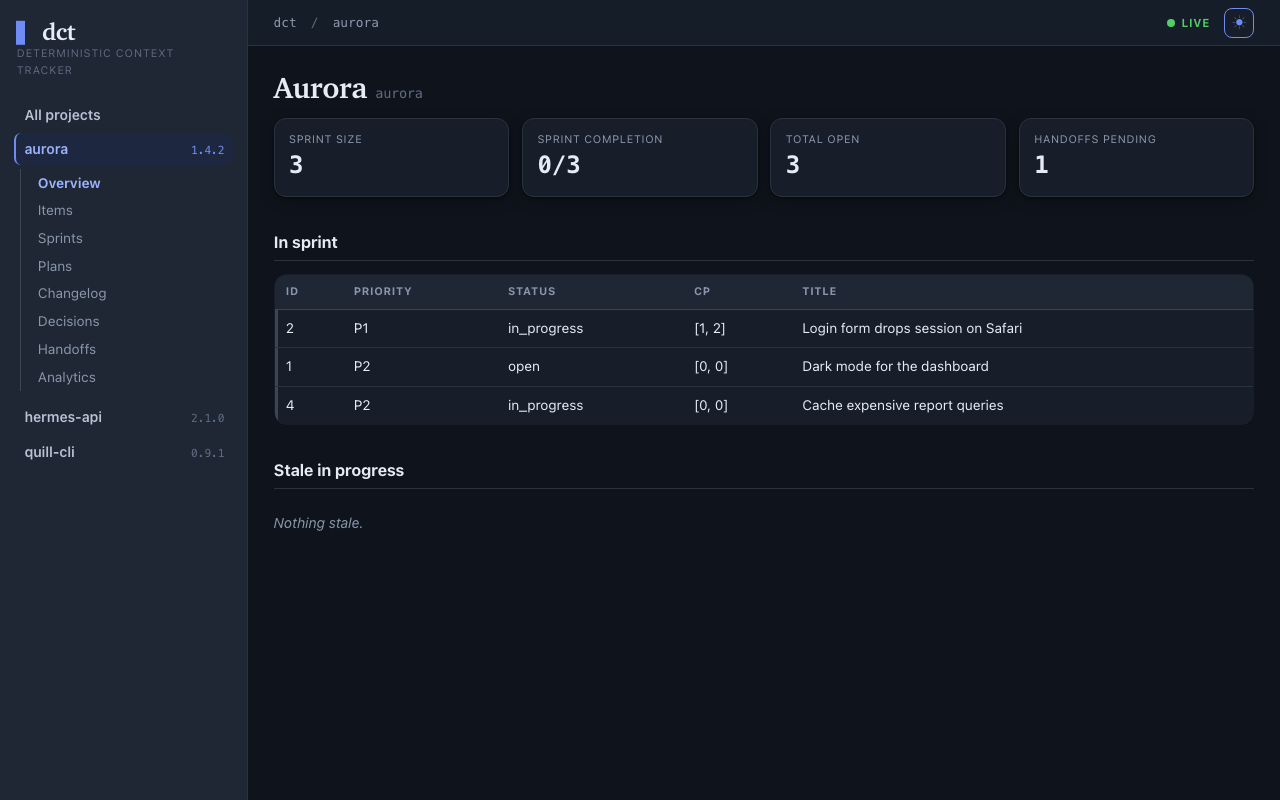
- Local dashboarddct web — a read-only web viewer over the same database.
The blast radius of a change, visible before the damage.
dcg parses your codebase into a graph database and serves it to agents over MCP — 17 tools, Go single binary, Neo4j storage, Python and Go parsers, Django-aware.
> get_impacted billing/models.py::Invoice.total

Invoice.total ─ impacted (14 nodes, depth ≤3)
├─ billing/views.py
│  ├─ InvoiceDetail.get_context_data  [dj:view]
│  └─ export_csv                      [fn]
├─ billing/serializers.py
│  └─ InvoiceSerializer.get_total     [drf:fld]
├─ reports/monthly.py
│  └─ build_revenue_report            [fn] ⚠ entry pt
└─ templates/billing/detail.html      [dj:tpl]

coverage: py 96% · dj 91% · tpl 78%
unparsed: 3 files (listed on request)
“Same input, same graph, every time.”
“It tells you what it doesn’t know” — every parser reports coverage.
“One graph query replaces hundreds of grep/read operations — faster, cheaper, more reliable.”
Philosophy
Deterministic
Facts come from a database, not from a model's best guess. Same input, same answer — the property everything else here depends on.
Append-only
A ledger, not a whiteboard. Notes, checkpoints and decisions are soft-deleted at most; nothing is ever lost.
Enforced, not suggested
Gates and hooks live in code, not in convention. A commit without a changelog entry doesn't happen; a feature with failing gates doesn't resolve.
Local-first
Your tracking lives in your own database — SQLite in your platform's data directory by default, first-class PostgreSQL when you want a server. Nothing leaves your machine.
Honest about limits
Every parser reports coverage. The tools tell you what they don't know, so you never mistake a partial answer for a complete one.
Open source
Built in the open.
The dc tools are developed publicly on GitHub. dct ships under the MIT license and takes issues and pull requests today; dcg opens up with its first public release. Bug reports, docs fixes and framework ideas are all welcome contributions.
Contribute on GitHub →